My-Cloner 3D Printer
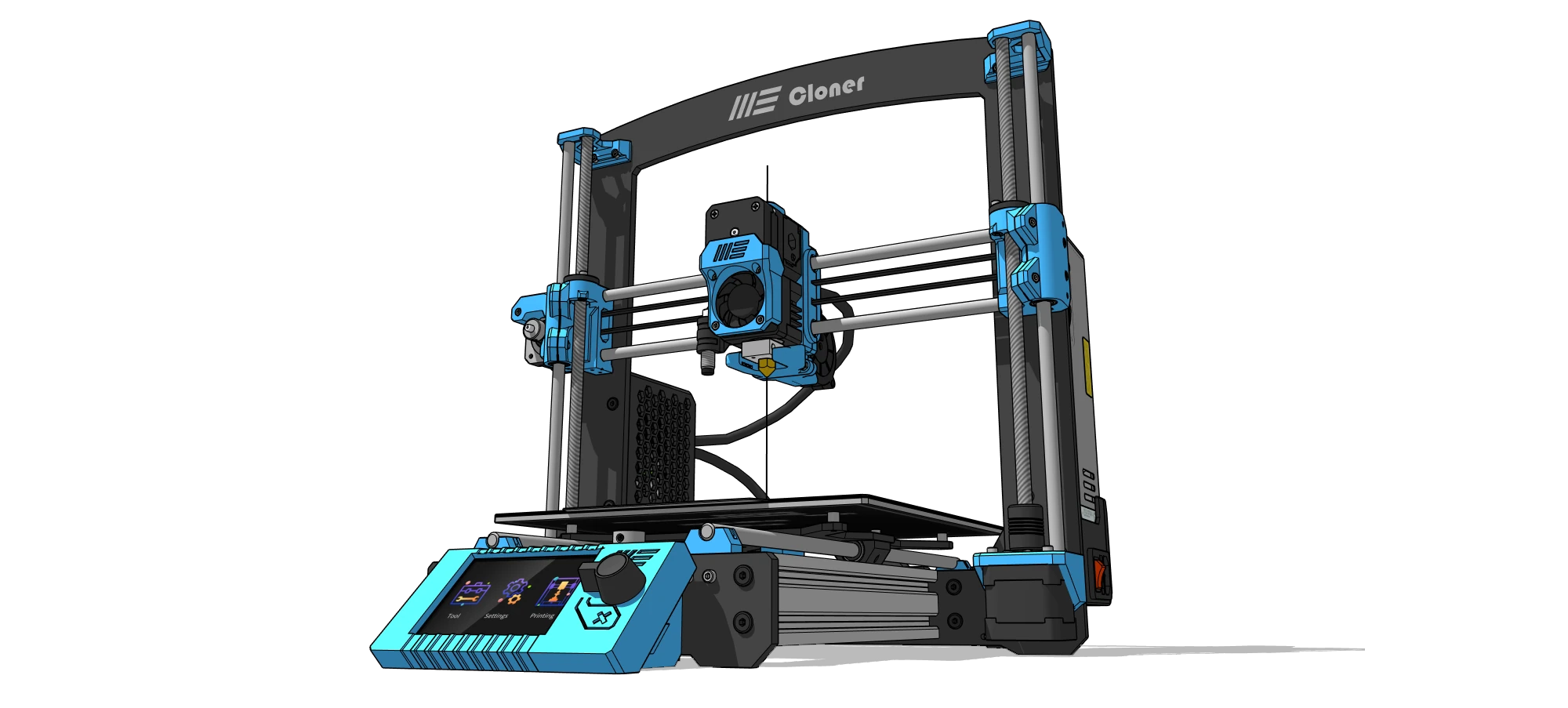
Welcome to the official documentation for the My-Cloner Rev A.
My-Cloner is an open-source Cartesian 3D printer project developed by MyMachines. This documentation is intended to provide the information required to understand, source, assemble, wire, configure, operate and maintain the machine.
Rev A — Active Validation
The Rev A mechanical definition and BOM are established, while several electrical and firmware parameters are still moving through physical bring-up.
Items that require machine testing are clearly marked as Pending validation rather than being presented as finished specifications.
-
Bill of Materials
Review the current Rev A mechanical, electronic and printed parts.
-
Assembly
Build the mechanical structure and install the Rev A electronics.
-
Wiring & Electronics
Understand the 24 V architecture, Robin Nano V3, TMC2209 drivers, sensors and interfaces.
-
Operation & Setup
Follow the first-power, calibration and operating procedures.
-
Software
Configure the software workflow around Klipper, Mainsail and OrcaSlicer.
-
Maintenance
Keep the machine mechanically and electrically reliable.
-
Troubleshooting
Diagnose common hardware, Klipper and print-quality problems.
-
Downloads
Access the current BOM, STL and CAD resources and see the status of firmware and slicer packages.
Rev A Technical Baseline
| Item | Rev A Definition |
|---|---|
| Build volume | 230 × 230 × 220 mm |
| Main voltage | 24 V DC |
| Controller | MKS Robin Nano V3 |
| Stepper drivers | 5 × TMC2209, UART |
| Host | Raspberry Pi Zero 2 W |
| Firmware | Klipper |
| Primary interface | Mainsail |
| Recommended slicer | OrcaSlicer |
| X/Y homing | TMC2209 sensorless homing |
| Z reference | P.I.N.D.A. probe |
| Local display | MKS TS35 V2.0 — integration under validation |
Open-Source Documentation
The essential information required to build and understand the My-Cloner is maintained in this documentation and the associated project files.
Where a Rev A parameter has not yet been physically validated, the documentation keeps that limitation explicit instead of borrowing values from older prototypes or unrelated printers.
Start with the Bill of Materials, then continue through Assembly, Wiring & Electronics and Operation & Use.